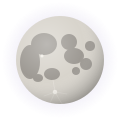
☽ Moon
Called Luna by the Romans and Selene by the Greeks
Night Moonlight
Which sign is the Moon in now?

Earth’s only natural satellite, which the Romans called Luna and the Greeks Selene, the goddess who drove her chariot across the night sky.
In myth
In the Homeric Hymn to Selene, the Moon is a goddess whose radiance, shining from her immortal head, embraces the earth. She bathes in the waters of Ocean, puts on her gleaming robes and drives her long-maned horses at full speed in the evening at mid-month, when her orbit is full and her light is brightest. Zeus loved her, and she bore him a daughter, Pandia. Hesiod makes her the daughter of the Titans Hyperion and Theia and the sister of Helios and Eos. In Rome, Luna had a temple on the Aventine Hill, and Monday, dies Lunae, was named for her.
Goddesses of the Moon
In the Goddess Encyclopedia, these goddesses count the Moon among their realms:
Artemis Selene Hecate Diana Luna Chang'e Ixchel Coyolxāuhqui Mama Killa Hina
How the moon got its name
NASA explains that our satellite is simply called the Moon because people didn’t know other moons existed until Galileo Galilei discovered four moons orbiting Jupiter in 1610. In Latin it was Luna, which gives us the adjective “lunar.”
Symbols
Chariot and horses Crescent moon Gleaming robes
The moon
The Moon turns on its axis in the same time it takes to go around Earth, so the same side always faces us. It likely formed after a Mars-sized body collided with Earth several billion years ago. Its dark patches, the maria, are impact basins that filled with lava between 4.2 and 1.2 billion years ago. The Moon is getting about an inch farther from Earth each year, and Apollo astronauts brought back 382 kg of its rocks and soil.
- Diameter
- 3,475 km 0.27 × Earth
- Mass
- 0.0735 × 10²⁴ kg 1.2% of Earth’s
- Gravity
- 1.62 m/s² 0.165 × Earth's, about a sixth
- Distance from Earth
- 384,400 km 363,300 to 405,500 km, nearest to farthest
- Once around Earth
- 27.3 days measured against the stars
- New moon to new moon
- 29.5 days the month of phases
- Spins once in
- 27.3 days so the same side always faces Earth
- Surface temperature
- 127 °C in sunlight about −173 °C in darkness
Figures from NASA’s Moon Fact Sheet; the surface temperatures are from NASA’s Moon facts page. Comparisons with Earth are from the fact sheet.
Learn more
- Homeric Hymn 32, to Selene (Evelyn-White translation), Perseus
- Hesiod, Theogony 371 ff. (Evelyn-White translation), Perseus
- Moon facts, NASA Science
- NASA Moon Fact Sheet (all figures)