Nebulas and galaxies from the Hubble and James Webb space telescopes, ready to print and send.
Postcards
The pictures are from the Deep Sky Gallery: NASA releases, in the public domain, with each
team credited on the back as NASA asks (NGC 2623 is an ESA/Hubble picture, shared under CC BY 4.0). Each picture
fills the whole front, so the edges of the wider ones are trimmed; the dark skies use a good deal of ink.
“Print postcard” makes real postcards: the picture on one side and a postcard back on the other, with what the
picture shows and room for a message, an address and a stamp.
Fronts printed. Put the printed pages back in the paper tray to print on their blank side:
If you’re not sure which way round, try it with one page first.
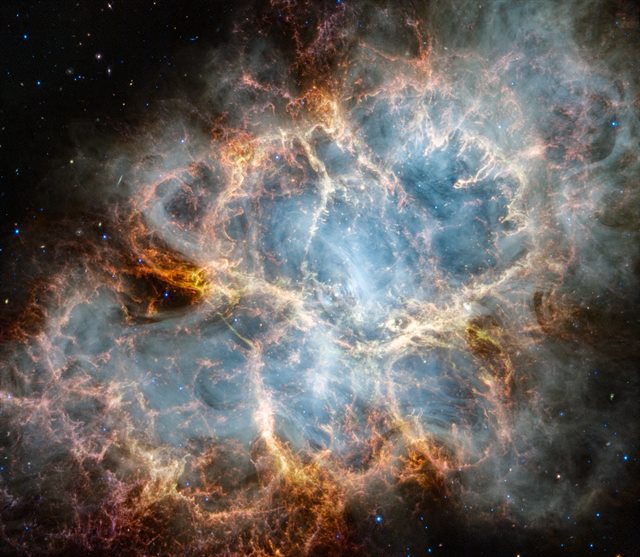
The Crab NebulaJames Webb Space Telescope, 2023NASA, ESA, CSA, STScI, Tea Temim (Princeton University); image processing: Joseph DePasquale (STScI)The remains of an exploded star in infrared: red-orange filaments of sulfur gas, yellow-white and green ridges of dust, a milky glow, and at the centre the bright, fast-spinning neutron star.Public domain, via NASA
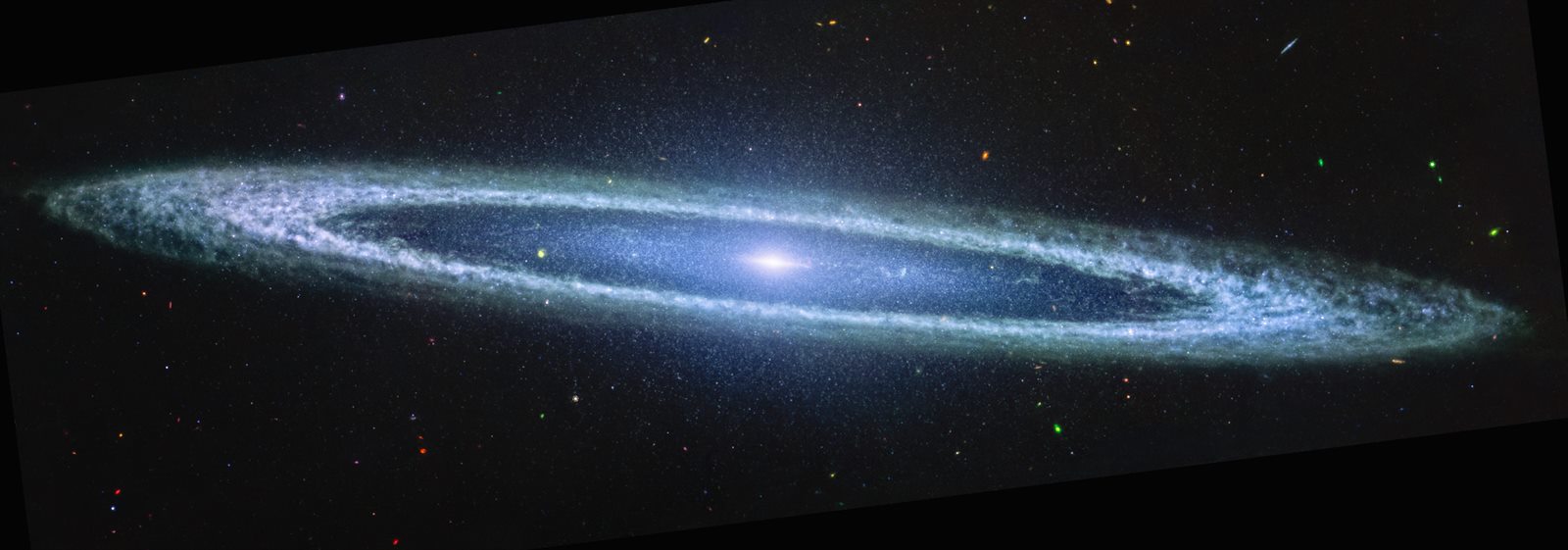
The Sombrero Galaxy (M104)James Webb Space Telescope, 2024NASA, ESA, CSA, STScI, Hubble Heritage Project (STScI, AURA)A spiral galaxy seen almost edge-on, in mid-infrared light: Webb sees past the glow of its central bulge of stars to a smooth inner disk, inside the clumpy dust of the outer ring.Public domain, via NASA
NGC 346James Webb Space Telescope, 2024NASA, ESA, CSA, STScI, Olivia C. Jones (UK ATC), Guido De Marchi (ESTEC), Margaret Meixner (USRA), Antonella Nota (ESA)A massive cluster of young stars in the Small Magellanic Cloud, a small galaxy next to ours. In infrared, Webb sees through the clouds of gas to more of the cluster’s structure.Public domain, via Wikimedia Commons
Arp 142, the Penguin and the EggJames Webb Space Telescope, 2024NASA, ESA, CSA, STScIThe Penguin and the Egg, two galaxies in the middle of an encounter, in near-infrared light. A faint bridge of stars, gas and dust joins the pair, and many more distant galaxies shine behind them.Public domain, via Wikimedia Commons
NGC 695Hubble Space Telescope, 2008NASA, ESA, the Hubble Heritage (STScI/AURA)-ESA/Hubble Collaboration, and A. Evans (University of Virginia, Charlottesville/NRAO/Stony Brook University)A disturbed spiral galaxy, seen face-on, with loosely wound arms and knots of new stars tangled in dust and gas. NASA likens it to a revolving tornado. A small companion galaxy, just outside the picture, is tugging at it.Public domain, via Wikimedia Commons
NGC 2392, the Lion NebulaJames Webb Space Telescope, 2026NASA, ESA, CSA, STScI; image processing: Alyssa Pagan (STScI)The glowing remains of a dying, Sun-like star, first spotted by William Herschel in 1787. Webb's team calls it the Lion Nebula: the white dwarf at the centre is the lion's nose, a bubble of hot gas and dust makes the face, and a shell of dust with comet-like tufts makes the mane.Public domain, via NASA
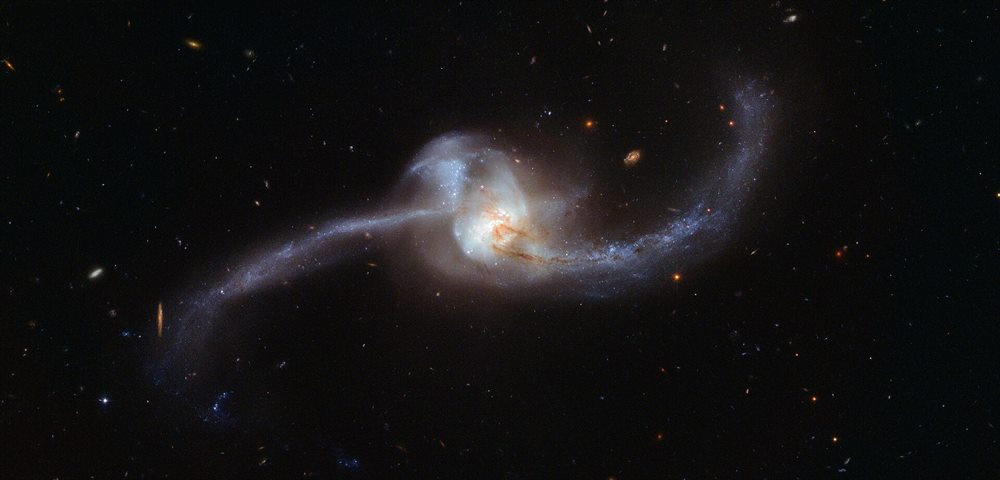
NGC 2623Hubble Space Telescope, 2017ESA/Hubble & NASATwo galaxies that collided and are merging into one, leaving sweeping tails of stars, gas and dust about 50,000 light-years from end to end. The bright blue patches are clusters of newborn stars. NASA notes that the Milky Way may one day look like this, after it meets the Andromeda Galaxy.CC BY 4.0, via NASA
M66 (NGC 3627)Hubble Space Telescope, 2024NASA, ESA, CSA, STScI, Janice Lee (STScI), Thomas Williams (Oxford), PHANGS TeamHubble's view for the PHANGS survey of nearby galaxies: dark brown lanes of dust follow the spiral arms, young stars shine blue and purple, and older stars give the centre a yellow glow.Public domain, via Wikimedia Commons
The jet of M87Hubble Space Telescope, 2000NASA and the Hubble Heritage Team (STScI/AURA)A jet of subatomic particles, shot out at nearly the speed of light by the black hole at the heart of the giant galaxy M87, seen here by Hubble in ultraviolet, blue, green and infrared light.Public domain, via Wikimedia Commons
NGC 5793Hubble Space Telescope, 2014NASA, ESA, and E. Perlman (Florida Institute of Technology)A spiral galaxy with a striking dust lane and an unusually bright centre. It's a Seyfert galaxy: the light at its heart is thought to come from a supermassive black hole pulling in gas and dust.Public domain, via Wikimedia Commons
The Cat's Paw Nebula (NGC 6334)James Webb Space Telescope, 2025NASA, ESA, CSA, STScIA close look at one "toe bean" of a huge star-forming cloud, made for Webb's third anniversary. Massive young stars are carving away the gas and dust around them; their light makes the blue glow.Public domain, via Wikimedia Commons
The Lagoon NebulaHubble Space Telescope, 2018NASA, ESA, and STScIThe heart of a vast stellar nursery, photographed for Hubble's 28th anniversary. The young giant star Herschel 36, about 200,000 times brighter than the Sun, is blasting out radiation and winds that carve ridges and caves in the gas and dust.Public domain, via Wikimedia Commons
Hickson Compact Group 87Hubble Space Telescope, 1999The Hubble Heritage Team (AURA/STScI/NASA)Four galaxies bound together by gravity, slowly circling one another over hundreds of millions of years. Visitors to the Hubble Heritage website chose it for Hubble to photograph.Public domain, via Wikimedia Commons
The Helix Nebula (NGC 7293)Hubble Space Telescope, 2004NASA, ESA, C.R. O'Dell (Vanderbilt University), M. Meixner and P. McCullough (STScI)The gas thrown off by a dying star. The picture joins Hubble's close-up detail with a wider view from the 4-metre telescope at Cerro Tololo, Chile.Public domain, via Wikimedia Commons
M74 (NGC 628)Hubble Space Telescope, 2024NASA, ESA, CSA, STScI, Janice Lee (STScI), Thomas Williams (Oxford), PHANGS TeamA spiral galaxy seen face-on, in Hubble's view for the PHANGS survey. Dust lanes wind along the arms, and the pink knots are regions where hot young stars light up hydrogen gas.Public domain, via Wikimedia Commons