Deep Sky Gallery
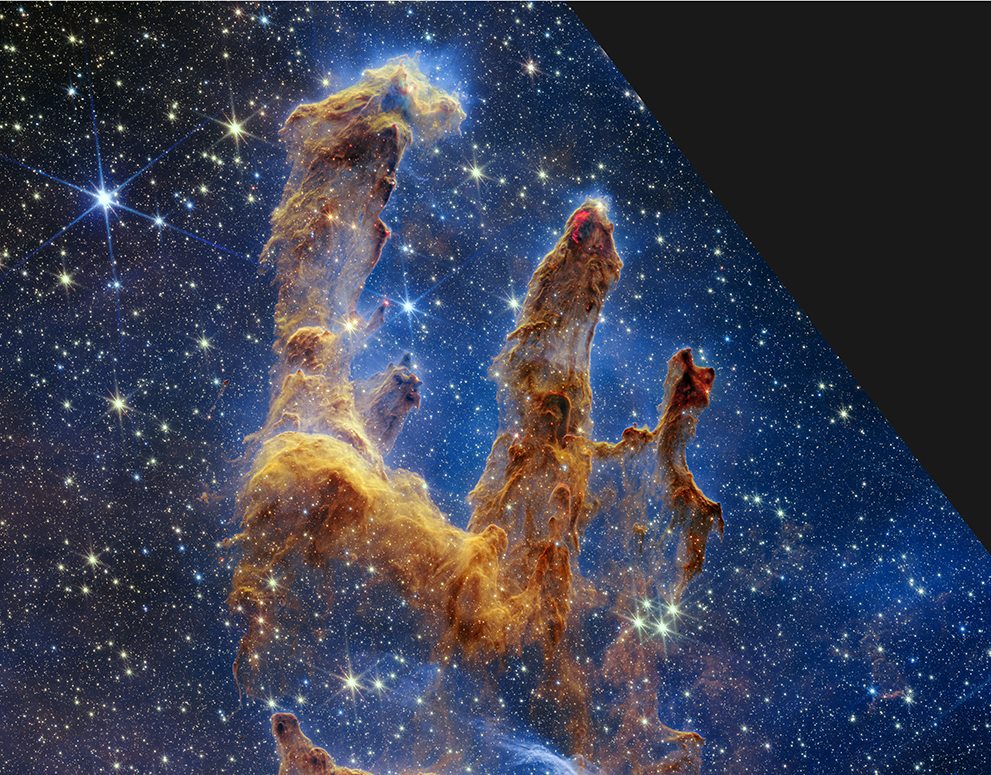
Nebulas and galaxies from two space telescopes. Hubble sees mostly visible and ultraviolet light; Webb sees infrared. Dust blocks visible light but glows in infrared, so the same patch of sky can look completely different through each one.
Hubble and Webb, side by side
Drag the line (or use the arrow keys) to wipe from Hubble's view to Webb's.
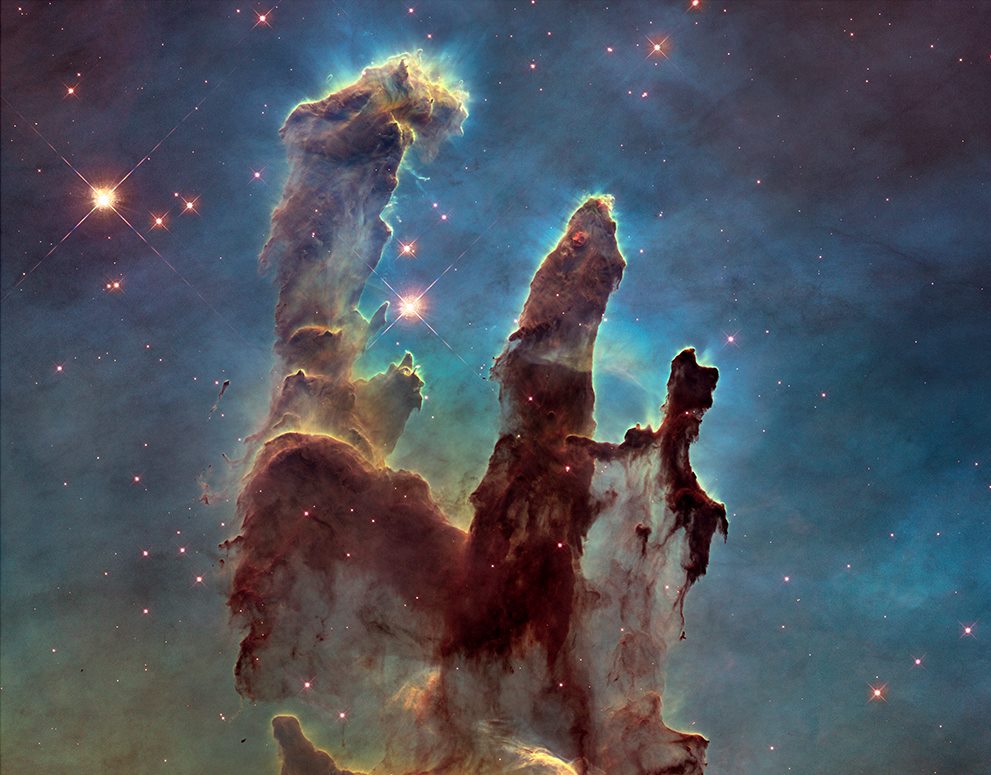
 Hubble, 2014 · visible light
Webb, 2022 · near-infrared
The Pillars of Creation
star-forming region in the Eagle Nebula (M16) · in the constellation Serpens · about 6,500 light-years away
Towers of cold gas and dust where new stars are forming. Near-infrared light passes through much of the dust, so in Webb's view the pillars turn see-through and many more stars appear, some of them still forming.
Image: NASA, ESA, CSA, STScI, Hubble Heritage Project; image processing: Joseph DePasquale, Anton Koekemoer and Alyssa Pagan (STScI) · source · public domain
Nebulas and galaxies
More pictures from Hubble and Webb. Click one to see it larger.
-
NGC 695
interacting spiral galaxy · about 450 million light-years · Hubble, 2008
-
NGC 2392, the Lion Nebula
planetary nebula · more than 2,870 light-years · Webb, 2026
-
NGC 2623
merging galaxies · about 250 million light-years · Hubble, 2017
-
M66 (NGC 3627)
spiral galaxy · about 36 million light-years · Hubble, 2024
-
The jet of M87
giant elliptical galaxy · about 54 million light-years · Hubble, 2000
-
NGC 5793
spiral galaxy · over 150 million light-years · Hubble, 2014
-
The Cat's Paw Nebula (NGC 6334)
star-forming region · about 4,000 light-years · Webb, 2025
-
The Lagoon Nebula
stellar nursery · about 4,000 light-years · Hubble, 2018
-
Hickson Compact Group 87
group of four galaxies · about 400 million light-years · Hubble, 1999
-
The Helix Nebula (NGC 7293)
planetary nebula · about 690 light-years · Hubble, 2004
-
M74 (NGC 628)
spiral galaxy · about 32 million light-years · Hubble, 2024
All pictures are NASA releases (NASA, ESA, CSA and STScI for Webb; NASA, ESA and STScI for Hubble), public domain in the US, except NGC 2623, credited ESA/Hubble & NASA. Each picture's own credit is in its enlarged view.