⚳ Ceres
Named for the Roman goddess Ceres (Greek: Demeter)
Grain Harvest Farming Peace Laws

Goddess of grain and the harvest, who first broke the soil with the plough.
The goddess
Ceres was the Roman goddess of grain and harvests. In Ovid’s Metamorphoses she is the first to break the soil with the plough, the first to give the earth its crops and wholesome food, and the first to give laws, and in his Fasti she leads people from acorns to more useful food. “Ceres delights in peace,” Ovid says, and her games came in April. Her best-known story is set in Sicily, her favorite home: while her daughter Persephone (the Romans’ Proserpina) was gathering flowers, Persephone’s uncle, the god of the underworld, saw her and carried her off. Ceres searched for her night and day, kindling two pine trees on Mount Etna as torches, and a torch is still carried at her rites, Ovid says. In the end Jupiter promised that Persephone would spend twice three months of each year in heaven. Cicero wrote that it was an ancient belief that the whole island of Sicily was sacred to Ceres and her daughter Libera.
More about the goddess on the Demeter page: her stories, symbols and correspondences →
How the dwarf planet got its name
On January 1, 1801, using the Ramsden Circle at his observatory in Palermo, Sicily, Giuseppe Piazzi saw an object that moved against the background stars. King Ferdinand of Sicily had made him the first director of the Palermo observatory, and Piazzi named his find Ceres Ferdinandea; the “Ferdinandea” was later dropped. NASA notes that it is named for the Roman goddess of corn and harvests. It was the first member of the asteroid belt to be discovered, and in 2006 astronomers classified it as a dwarf planet. When NASA’s Dawn spacecraft arrived in 2015, Ceres became the first dwarf planet to be visited by a spacecraft.
Symbols
Grain Plough Torch
The dwarf planet
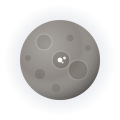
The only dwarf planet in the inner solar system, and about a quarter of the asteroid belt’s total mass. Ceres probably has a solid core and a mantle made of water ice, under a rocky, dusty crust with large salt deposits. It is covered in countless small, young craters, none of them larger than 280 km across, and some craters hold regions that are always in shadow, where water ice could last for long periods. NASA notes that Ceres may even have more water than Earth does. It has no moons and no rings.
- Diameter
- 939 km 0.27 × the Moon’s
- Mass
- 9.38 × 10²⁰ kg 1.29% of the Moon’s
- Density
- 2.16 g/cm³ Earth’s is 5.5, water’s 1
- Spins once in
- 9.1 hours
- Length of year
- 4.6 Earth years one trip around the Sun
- Distance from the Sun
- 414 million km 2.77 AU (Earth = 1), on average
Figures from NASA JPL’s Small-Body Database, which names the study each one comes from; the mass is worked out from JPL’s figure for its gravity. Comparisons with the Moon and Earth use NASA’s Planetary Fact Sheet.
Learn more
- Ovid, Metamorphoses 5.341 ff. (More translation), Perseus
- Ovid, Fasti 4 (Frazer translation), Theoi
- Cicero, Against Verres 2.4.106 ff., Perseus
- Demeter, Theoi Greek Mythology
- Giuseppe Piazzi, Vatican Observatory
- Ceres facts, NASA Science
- NASA JPL Small-Body Database (all figures)