⚴ Pallas
Named for the Greek goddess Pallas Athena (Roman: Minerva)
Wisdom Crafts War Athens

Goddess of wisdom, crafts and war, born in golden armor from the head of Zeus.
The goddess
Pallas Athena was the Greek goddess of wisdom, crafts and war. Hesiod says her mother was Metis, “wisest among gods and mortal men,” and that her daughter would be “equal to her father in strength and in wise understanding”; Zeus swallowed Metis before the birth, and the Homeric Hymn to Athena tells how he bore the goddess “from his awful head, arrayed in warlike arms of flashing gold,” shaking a sharp spear. Another hymn says she delights in war and in “preparing famous crafts,” and that she first taught craftsmen to make chariots. She and Poseidon competed for Athens: Poseidon struck the Acropolis with his trident and made a sea, Athena planted an olive tree, and the twelve gods awarded the land to her because she had planted first. Apollodorus says she was brought up by Triton together with his daughter Pallas; when Pallas fell in a quarrel between the two girls, Athena, “exceedingly grieved for her,” made a wooden image in her likeness, the Palladium.
More about the goddess on the Athena page: her stories, symbols and correspondences →
How the asteroid got its name
Heinrich Wilhelm Olbers had recovered Ceres from his observatory in Bremen on the last day of 1801, and on March 28, 1802 he spotted another similar object: Pallas, the second asteroid to be discovered. Britannica notes that it is named after Pallas Athena. The discoveries of Ceres and Pallas, and of Juno and Vesta over the next five years, gave rise to the long-lived idea, no longer accepted, that the asteroids were the remains of a “missing” planet between Mars and Jupiter that had broken up.
Symbols
Olive tree Spear Golden armor Aegis
The asteroid
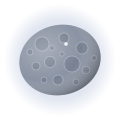
The third largest asteroid in the belt, and the largest that no spacecraft has visited yet. Its orbit is tilted about 35° to Earth’s, rather steep for an asteroid, so other asteroids hit it fast: about 11.5 km a second on average, roughly twice the belt’s average. Telescope images show numerous craters more than 30 km wide and two large impact basins. Its density fits a body like the carbonaceous chondrite meteorites, and its surface is known to contain hydrated minerals, a sign that water once altered its rock; a bright spot on it may be salt left behind by that water.
- Diameter
- 513 km 0.15 × the Moon’s
- Mass
- 2.04 × 10²⁰ kg 0.28% of the Moon’s
- Density
- 2.89 g/cm³ Earth’s is 5.5, water’s 1
- Spins once in
- 7.8 hours
- Length of year
- 4.6 Earth years one trip around the Sun
- Distance from the Sun
- 414 million km 2.77 AU (Earth = 1), on average
Figures from NASA JPL’s Small-Body Database, which names the study each one comes from; the mass is worked out from JPL’s figure for its gravity. Comparisons with the Moon and Earth use NASA’s Planetary Fact Sheet.
Learn more
- Hesiod, Theogony 886 ff. (Evelyn-White translation), Perseus
- Homeric Hymn 28, to Athena, Perseus
- Homeric Hymn 5, to Aphrodite (lines 7–15), Perseus
- Apollodorus, Library 3.12.3 and 3.14.1 (Frazer translation), Perseus
- Athena, Theoi Greek Mythology
- Heinrich Olbers, Linda Hall Library
- Pallas, Encyclopaedia Britannica (Tedesco)
- Marsset et al., “The violent collisional history of aqueously evolved (2) Pallas” (Nature Astronomy, 2020)
- NASA JPL Small-Body Database (all figures)