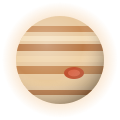
♃ Jupiter
Named for the Roman god Jupiter (Greek: Zeus)
Sky Thunder King of the gods Oaths

King of the gods, lord of the sky and thunder, and chief god of the Roman state.
The god
Jupiter was the god of the sky and thunder, the king of the gods, and the chief deity of the Roman state. His name comes from old Italic words for “sky” and “father,” so it means “sky father.” In the Capitoline Triad, with Juno and Minerva, he was the central guardian of the state, and his great temple on the Capitoline Hill was dedicated to Jupiter Optimus Maximus, “best and greatest”; victorious generals laid the tokens of their victory at the feet of his statue there. As the sky god he was the divine witness to oaths. His emblem was the thunderbolt, his sacred animal the eagle and his sacred tree the oak. The Romans saw him as the equal of the Greek Zeus.
How the planet got its name
NASA notes that the biggest planet takes its name from the king of the Roman gods. It is the third-brightest natural object in the night sky, after the Moon and Venus, and takes almost 12 years to circle the Sun. Babylonian astronomers associated it with Marduk, their chief god. Galileo and Simon Marius each spotted its four largest moons around January 1610, and Marius, on Johannes Kepler’s suggestion, named them Io, Europa, Ganymede and Callisto, for four lovers of Zeus.
Symbols
Eagle Thunderbolt Oak
The planet
A gas giant made, like the Sun, mostly of hydrogen and helium. Jupiter took most of the material left over after the Sun formed and ended up with more than twice the combined material of all the other bodies in the solar system. Its stripes are cold, windy clouds of ammonia and water, and the Great Red Spot is a storm bigger than Earth that has raged for hundreds of years. Its moon Io is the most volcanically active body in the solar system, and Europa may hide a vast ocean beneath its icy crust. Its rings were discovered by Voyager 1 in 1979.
- Diameter
- 142,984 km 11 × Earth
- Mass
- 1898 × 10²⁴ kg 318 × Earth
- Gravity
- 23.1 m/s² 2.4 × Earth's
- Length of day
- 9.9 hours sunrise to sunrise
- Length of year
- 11.9 Earth years one trip around the Sun
- Distance from the Sun
- 778.5 million km 5.2 AU (Earth = 1)
- Average temperature
- -110 °C -166 °F
- Moons
- 95 NASA’s count
- Rings
- Yes
Figures from NASA’s Planetary Fact Sheet; the temperature is its “mean temperature.” Comparisons with Earth are worked out from the same sheet.
Learn more
- Jupiter (god), Wikipedia
- Galilean moons, Wikipedia
- Zeus, Theoi Greek Mythology
- Jupiter facts, NASA Science
- NASA Planetary Fact Sheet (all figures)