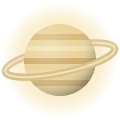
♄ Saturn
Named for the Roman god Saturn (Greek: Kronos)
Agriculture Abundance Wealth Time

The god of agriculture, abundance and wealth, and later of time.
The god
Saturn was the Roman god of agriculture, abundance and wealth, and later of time. The Romans remembered a far-off age when Saturn and Janus reigned on the site of Rome before the city was founded, and pictured his reign as a Golden Age of abundance and peace, when people enjoyed the earth’s bounty without labor. His festival, the Saturnalia, held from December 17, turned everyday life upside down: there was a public banquet, gift-giving (often small figurines of wax or pottery), candles and gambling, and masters waited on their slaves at table. His temple in the Roman Forum held the state treasury. He was identified with the Greek Kronos, who was sometimes confused with Chronos, “Time,” and the sickle or scythe of Father Time comes from his farming tool. Saturday is named for him.
How the planet got its name
Saturn is the farthest planet from Earth that can be seen with the unaided eye, so it has been known since ancient times, and Babylonian astronomers carefully recorded its movements. It takes about 29½ years to circle the Sun. NASA notes it is named for the Roman god of agriculture and wealth, the father of Jupiter.
Symbols
Sickle Scythe
The planet
Like Jupiter, Saturn is made mostly of hydrogen and helium, around a dense core of metals like iron and nickel. It is the only planet less dense than water: it could float in a bathtub, if there were one big enough. Its rings stretch up to 282,000 km from the planet but the main rings are typically only about 10 meters thick. Its moons include Enceladus, which sprays jets of water, and smoggy Titan, with its lakes of methane; both have oceans inside.
- Diameter
- 120,536 km 9.4 × Earth
- Mass
- 568 × 10²⁴ kg 95 × Earth
- Gravity
- 9.0 m/s² 0.92 × Earth's
- Length of day
- 10.7 hours sunrise to sunrise
- Length of year
- 29.4 Earth years one trip around the Sun
- Distance from the Sun
- 1,432 million km 9.57 AU (Earth = 1)
- Average temperature
- -140 °C -220 °F
- Moons
- 274 NASA’s count
- Rings
- Yes
Figures from NASA’s Planetary Fact Sheet; the temperature is its “mean temperature.” Comparisons with Earth are worked out from the same sheet.
Learn more
- Saturn (mythology), Wikipedia
- Saturnalia, Wikipedia
- Kronos, Theoi Greek Mythology
- Saturn facts, NASA Science
- NASA Planetary Fact Sheet (all figures)