⚶ Vesta
Named for the Roman goddess Vesta (Greek: Hestia)
The hearth Home and household Sacred fire

Goddess of the hearth and household, who was nothing but living flame.
The goddess
Vesta was the Roman goddess of the hearth and household. Ovid says she was “naught but the living flame” and that there was no image of her in her temple, which was round like the earth, with no corners; she was tended by virgin priestesses. On her day, June 9, loaves were hung on donkeys decked with wreaths, and flowery garlands covered the rough millstones. Her Greek counterpart Hestia was the first-born child of Kronos; she vowed to stay a maiden all her days, and instead of marriage Zeus gave her a place in the middle of the house and a share of honor in all the temples of the gods.
How the asteroid got its name
Heinrich Wilhelm Olbers, who had already found Pallas, discovered Vesta at Bremen on March 29, 1807, and Carl Friedrich Gauss named it after the Roman goddess of the hearth and household. NASA’s Dawn spacecraft circled Vesta from July 16, 2011 until September 5, 2012, before going on to Ceres.
Symbols
Fire The hearth Donkey Millstones
The asteroid
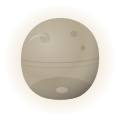
The second most massive body in the asteroid belt, after Ceres. Vesta has separated into a crust, mantle and core, the denser material sinking to the middle and the lighter rising. Its Rheasilvia crater is about 500 km wide, almost as wide as Vesta itself, and a second huge crater, Veneneia, is about 400 km across. A system of troughs circles its equator; the largest, Divalia Fossa, is bigger than the Grand Canyon. Vesta seems to be the source of the howardite, eucrite and diogenite meteorites found on Earth, and it has one of the largest ranges of brightness of any rocky body in the solar system.
- Diameter
- 523 km 0.15 × the Moon’s
- Mass
- 2.59 × 10²⁰ kg 0.35% of the Moon’s
- Density
- 3.46 g/cm³ Earth’s is 5.5, water’s 1
- Spins once in
- 5.3 hours
- Length of year
- 3.6 Earth years one trip around the Sun
- Distance from the Sun
- 353 million km 2.36 AU (Earth = 1), on average
Figures from NASA JPL’s Small-Body Database, which names the study each one comes from; the mass is worked out from JPL’s figure for its gravity. Comparisons with the Moon and Earth use NASA’s Planetary Fact Sheet.
Learn more
- Ovid, Fasti 6 (Frazer translation), Theoi
- Homeric Hymn 5, to Aphrodite (lines 21–32, Hestia), Perseus
- Hestia, Theoi Greek Mythology
- 4 Vesta, NASA Science
- NASA JPL Small-Body Database (all figures)