⚵ Juno
Named for the Roman goddess Juno (Greek: Hera)
Queen of the gods Childbirth Married women

Queen of the gods, sister and wife of Jupiter, who brought babies into the light.
The goddess
Juno was the queen of the Roman gods. In Ovid’s Fasti she calls herself both the sister and the wife of Jupiter, asks why else she is called “Queen and chief of goddesses,” and claims that the month of June takes its name from hers. The first day of every month, the Kalends, was in her care. As Juno Lucina she watched over childbirth: on March 1, the day the Latin matrons were said to have founded her temple, women wreathed their heads with flowers and prayed, “Thou, Lucina, hast bestowed on us the light of life.” As Juno Moneta she had a temple in Rome where money was coined, and moneta became the Latin word for the mint and for coined money itself. Ovid also tells how she set the eyes of her watchman Argus in the feathers of her bird, the peacock, “emblazoning its tail with starry gems.”
More about the goddess on the Juno page: her stories, symbols and correspondences →
How the asteroid got its name
Karl Ludwig Harding discovered and named Juno, the third minor planet to be found, on September 1, 1804, while he was assistant to Johann Hieronymus Schröter at Schröter’s observatory in Lilienthal, near Bremen. He found it while checking star charts at the telescope. Harding later became a professor at Göttingen and published a star atlas of more than 120,000 stars.
Symbols
Peacock Flowers Coins
The asteroid
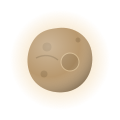
A stony asteroid about 247 km across, much smaller than Ceres, Pallas and Vesta. JPL lists it among the S-type asteroids, which NASA describes as made up of silicate materials and nickel-iron. It spins once every 7.2 hours and circles the Sun a little closer in than Ceres and Pallas.
- Diameter
- 247 km 0.07 × the Moon’s
- Spins once in
- 7.2 hours
- Length of year
- 4.4 Earth years one trip around the Sun
- Distance from the Sun
- 399 million km 2.67 AU (Earth = 1), on average
Figures from NASA JPL’s Small-Body Database, which names the study each one comes from; the mass is worked out from JPL’s figure for its gravity. Comparisons with the Moon and Earth use NASA’s Planetary Fact Sheet.
Learn more
- Ovid, Fasti 1 (Frazer translation), Theoi
- Ovid, Fasti 3 (Frazer translation), Theoi
- Ovid, Fasti 6 (Frazer translation), Theoi
- Ovid, Metamorphoses 1 (More translation), Theoi
- Moneta, Lewis & Short Latin Dictionary, Perseus
- Hera, Theoi Greek Mythology
- Karl Ludwig Harding, Encyclopaedia Britannica
- Harding, Karl Ludwig, Neue Deutsche Biographie (in German)
- Asteroid facts (asteroid types), NASA Science
- NASA JPL Small-Body Database (all figures)